![[my] Wellness project](/assets/logos/my-wellness-project-bright-white.svg)

Most people reach for lavender when they think of essential oils and sleep. It's the obvious choice — calming, familiar, widely recommended. But here's what aromatherapy professionals know: lavender alone is just the starting point.
Single essential oils deliver one-dimensional aromatic profiles. Blends combine multiple oils to create effects no single oil can deliver on its own. The difference isn't subtle — it's the reason professional aromatherapists formulate blends instead of relying on single oils.
Essential oil blends create aromatic synergy. Different oils contain different chemical constituents, and when properly combined, these constituents work together to amplify the effect. You're not just adding more scent — you're creating complexity your nervous system responds to differently than single notes.
If you've been using lavender alone and wondering why the effect seems to diminish over time, you're experiencing aromatic adaptation. Blends solve this through layered complexity that prevents your nose from adapting the way it does with single oils.
Why blended essential oils outperform single oils.
Single essential oils contain one set of aromatic compounds. Blends combine multiple sets, creating effects no single oil can deliver alone.
Aromatic complexity
Single oils deliver one aromatic note. Blends create layered profiles — floral top notes, herbal middle notes, grounding base notes. Lavender's floral character combined with cedarwood's woody depth creates comprehensive calm — both uplifting and grounding at once. Single lavender can't deliver this, because it doesn't contain the woody compounds cedarwood provides.
Chemical synergy
Different essential oils contain different constituents. Linalool from lavender, sesquiterpenes from vetiver, and esters from chamomile don't just coexist — they work together. This is why professional aromatherapists blend: they're combining chemical profiles to create synergistic formulations where the whole delivers more than the sum of its parts.
Sustained effectiveness
Here's the problem with using the same single oil repeatedly: aromatic adaptation. Your olfactory system stops noticing static scents within a week. Blends prevent this through layered complexity — top notes evaporate quickly, middle notes emerge as the top notes fade, and base notes provide sustained presence. Your nose experiences continuous variation rather than a single static note. It's why lavender can seem to "stop working" after consistent use, while blends maintain their effect.
The essential components of an effective sleep blend.
Professional aromatherapists think in layers when formulating sleep blends. Each layer serves a specific aromatic function.
- Top notes (floral / bright) — light, volatile compounds that evaporate quickly, like Lavender and Roman Chamomile. They create the immediate calming impression when you first smell the blend.
- Middle notes (balancing / herbal) — Ho Wood, Marjoram, Ylang Ylang. They emerge as top notes fade, connecting the floral opening to the grounding base and providing sustained aromatic presence.
- Base notes (grounding / woody) — Cedarwood, Vetiver, Hawaiian Sandalwood. While top notes fade within 30 minutes, base notes persist for 6–8 hours or more. This is what keeps the blend working through the night.
- Enhancers (warm / sweet) — Vanilla. Without enhancers, many sleep blends feel medicinal; vanilla adds warmth that makes the blend comforting rather than merely calming.
Remove any layer and the aromatic progression breaks down. This is what separates professional formulations from DIY experiments.
dōTERRA Lavender Peace: a research-backed blend.
dōTERRA's Lavender Peace products use this professional layering approach in two formats — one for ambient diffusion, one for topical application.
Lavender Peace Restful Blend — ambient aromatherapy
The Lavender Peace Restful Blend is a 15 mL proprietary blend of nine essential oils with a warm, floral, herbal profile: Lavender, Roman Chamomile, Ho Wood, Ylang Ylang, Marjoram, Cedarwood, Vetiver, Hawaiian Sandalwood, and Vanilla — covering all four aromatic layers. Add 3–4 drops to your diffuser and run it through the night to fill your bedroom with layered aromatherapy you sleep inside.
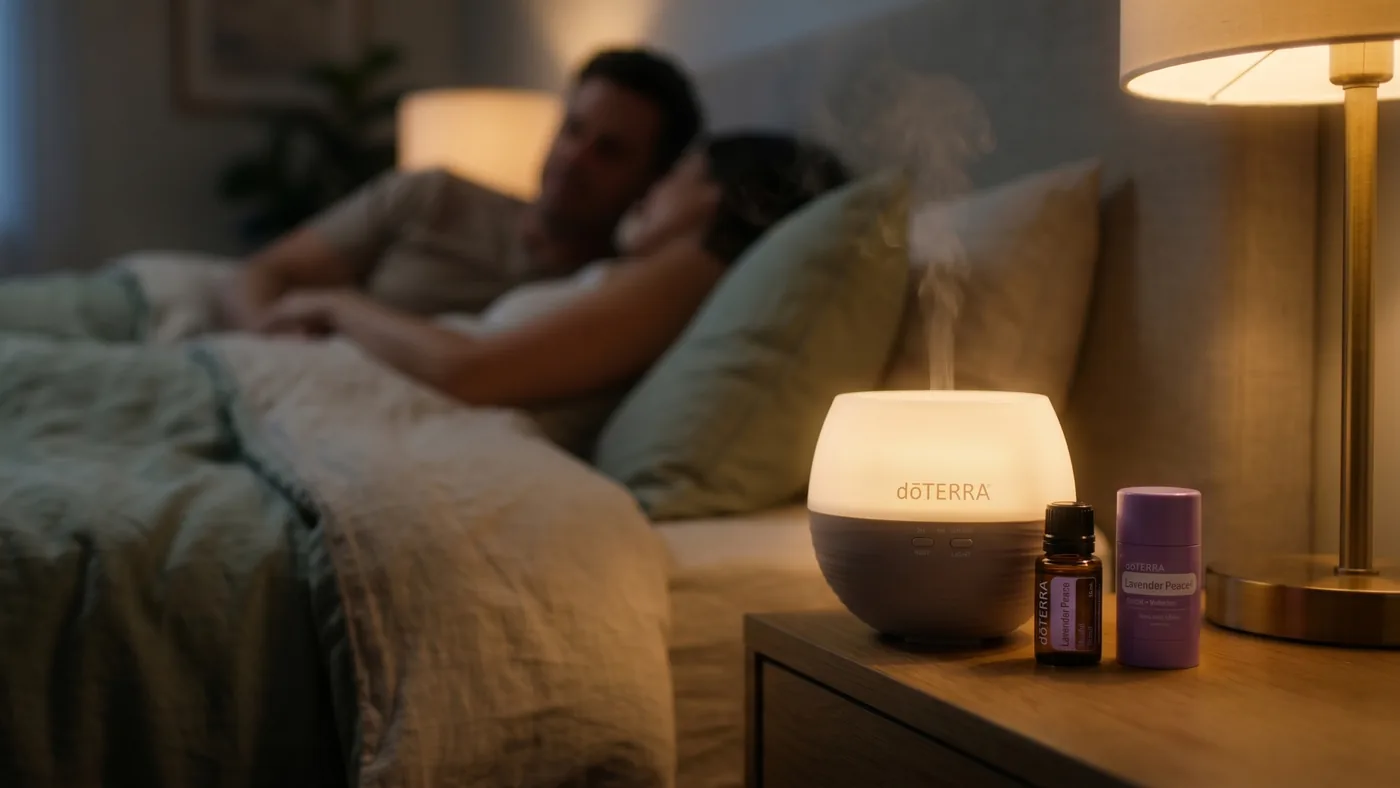
Lavender Peace Stick + Valerian — topical application
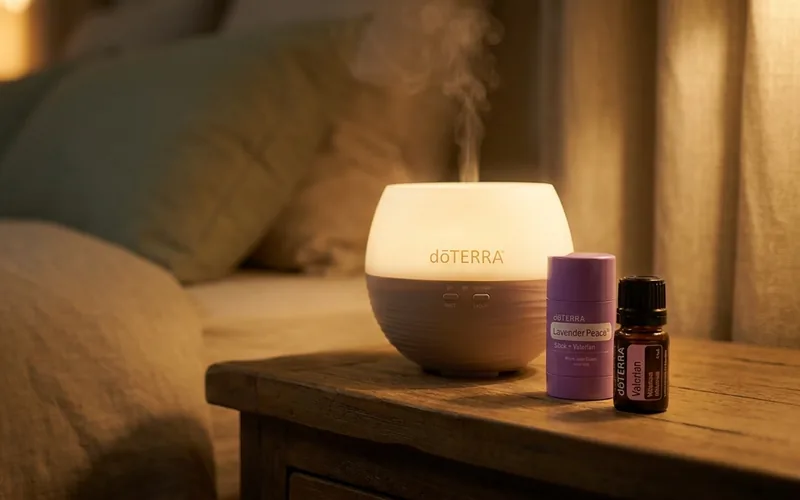
The Lavender Peace Stick + Valerian (30 g) takes the Lavender Peace blend and enhances it with valerian essential oil in a convenient stick format. Valerian has been used to support rest since ancient Greek and Roman times, delivering a warm, woody, earthy aroma that adds grounding depth. The stick is pre-diluted and ready to apply — no carrier oil, no dropper bottles at bedtime. Twist the base, apply to wrists, neck, chest, and feet as you get into bed; it goes on smoothly with a non-greasy feel.
Why both products work together
The Restful Blend creates an ambient environment (Step 3 of the Sleep Well Pack protocol). The Stick provides targeted topical application (Step 2). Together, they deliver comprehensive aromatic support — both ambient and concentrated. That's layered aromatherapy: multiple application methods working at once, rather than a single product doing all the work.
Why DIY blending costs more than you think.
To recreate something similar to Lavender Peace, you'd need nine individual essential oils: Lavender ($42), Cedarwood ($25), Roman Chamomile ($81), Vetiver ($78), Ylang Ylang ($68), Marjoram ($37), Hawaiian Sandalwood ($125), Ho Wood, and Vanilla.
- Total investment: $500+ — and you'll have significant excess, since blends use drops, not millilitres. Unless you plan to make the blend 50–100 times, much of that is wasted.
- The hidden costs — learning dilution ratios and aromatic balance, trial and error (your first attempts won't work well), time researching and testing, storage for nine bottles, and creating a topical stick format yourself.
- Sleep Well Pack alternative — $237 wholesale (inc. GST) with diffuser. Includes both Lavender Peace products, professionally formulated, CPTG® quality across all oils, free membership, and free shipping.
DIY: $500+, weeks of trial and error, uncertain results. Sleep Well Pack: $237, works immediately, proven formulation.
How to layer aromatherapy for better sleep.
The most effective approach uses multiple application methods at once — layered aromatherapy.
- Method 1 — Diffusion. Add 3–4 drops of Lavender Peace Restful Blend to your diffuser and run it through the night. Start it 30 minutes before bed so the blend fully develops before you settle in.
- Method 2 — Topical application. Apply the Lavender Peace Stick + Valerian to wrists, neck, chest, and feet as you get into bed. The ritual of application becomes your signal: the day is done, it's time to rest.
- Method 3 — Combined protocol. Use both. Start the diffuser 30 minutes before bed, complete your routine, get into bed, apply the Stick, and sleep in the ambient environment the diffuser created.
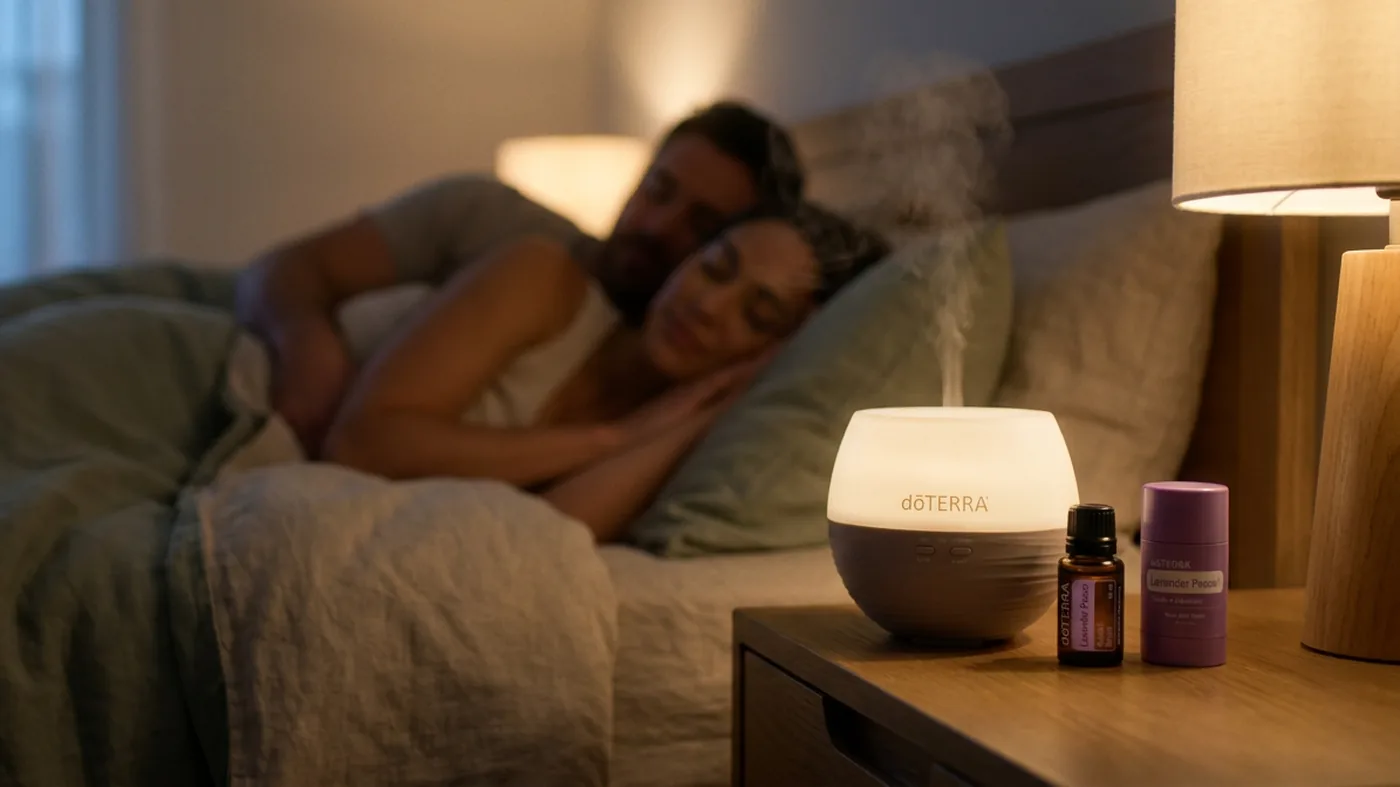
This combined approach is Steps 2 and 3 of the Sleep Well Pack protocol — ambient diffusion and concentrated topical application working together for comprehensive aromatic support.
Why lavender alone isn't enough.
If you've been using lavender oil for sleep for more than a week, you've probably noticed diminished effectiveness. This is aromatic adaptation — your olfactory system stops noticing static scents within days. The oil hasn't changed; your nervous system has adapted. Within three to five nights, most people report lavender seems less effective.
Blends prevent this through layered complexity. Top notes evaporate quickly, middle notes emerge as they fade, base notes provide sustained presence — your nose experiences continuous variation, so there's no single compound to adapt to.
Lavender is a top-to-middle note — bright, floral, light. It lacks the grounding woody base notes that anchor a sleep blend through the night.
Single lavender works well for three to five nights, then effectiveness drops as adaptation sets in. The Lavender Peace blend maintains its effect over time, thanks to a complex aromatic profile that resists adaptation.
Get both blends in the Sleep Well Pack.
The Sleep Well Pack includes both Lavender Peace products as part of a complete 4-step protocol:
- Step 1 — Lavender Peace Softgels (30 minutes before bed). An ARTG-listed therapeutic wellness supplement traditionally used in Western herbal medicine to decrease, reduce, and relieve sleeplessness.
- Step 2 — Lavender Peace Stick + Valerian (as you get into bed). Topical aromatherapy providing a soothing, calming aroma.
- Step 3 — Lavender Peace Restful Blend (throughout the night). Ambient diffusion creating a calming, restful environment.
- Step 4 — Lavender Touch Roll-On (throughout the day). Lavender is traditionally used in aromatherapy to reduce symptoms of stress.
The day protocol (Step 4) helps prevent stress from compounding; the night protocol (Steps 1–3) creates the conditions for restorative rest. The Petal Diffuser 2.0 is included so you can put the blend to work from the first night. $237 wholesale (inc. GST), diffuser included, free dōTERRA Wholesale Membership and free shipping.
dōTERRA Lavender Peace Softgels (ARTG 489563) are listed with the Therapeutic Goods Administration (TGA). Always read the label and follow the directions for use.
Common questions about essential oil blends for sleep.
Can I make my own sleep blend at home?
Yes, but you'll need six to nine individual oils ($500+), learn proper dilution ratios, and experiment to find a balance that works. Pre-formulated blends like Lavender Peace are research-backed, professionally tested, and work from first use.
What's the difference between the Stick and the Restful Blend?
The Restful Blend (15 mL) is for diffusion — ambient aromatherapy throughout your bedroom. The Stick (30 g) is pre-diluted for topical application to wrists, neck, chest, and feet. Use both together for complete aromatic support.
Why does the Stick contain valerian when the Restful Blend doesn't?
Valerian's warm, woody, earthy aroma adds grounding depth that enhances topical application. The Stick is formulated for concentrated use where valerian works best, while the Restful Blend is optimised for diffusion across larger spaces.
Is Lavender Peace better than single lavender oil?
Lavender Peace delivers layered complexity that prevents aromatic adaptation and provides sustained effectiveness. Single lavender works well for three to five nights, then tends to diminish. Lavender Peace maintains consistent effectiveness over time.
Can I use these blends for children?
The Lavender Peace products are formulated for adults. For children, consult a healthcare professional before use.
How long do the blends last?
The 15 mL Restful Blend provides roughly 75–100 uses (about 2.5–3 months of nightly diffusion). The 30 g Stick provides around 2–3 months of nightly application.
Do I need to use both products?
Both work independently, but using them together creates layered aromatherapy that delivers the most comprehensive support. That's why the Sleep Well Pack includes both, as Steps 2 and 3 of the protocol.