![[my] Wellness project](/assets/logos/my-wellness-project-bright-white.svg)

If stress from your day won't switch off at bedtime, you're not alone. When your mind stays active and your body stays tense, falling asleep becomes a battle — aromatherapy offers a different approach: managing stress through the day to create the foundation for restful sleep at night.
Why relaxation during the day matters for sleep at night.
Most people don't realise their sleep problems begin hours before bedtime. Throughout the day, stress and tension build up — each challenge, deadline, or worry adds another layer. By the time you're ready for bed, your body is still running on high alert no matter how tired you feel. Your nervous system doesn't have an off switch; it needs time and the right signals to shift from "alert and active" into "calm and ready to rest."
Most sleep solutions focus entirely on the 30 minutes before you close your eyes — but that misses the bigger picture. The more effectively you manage stress during the day, the easier the transition into sleep at night. Think prevention rather than intervention: you're not trying to undo 12 hours of accumulated tension in 30 minutes. A quick application to your wrists during a stressful moment, diffusion in the afternoon, a moment of intentional breathing with a calming scent — these small interventions compound over the day, making the evening transition far easier.
The science behind aromatherapy for stress and sleep.
The olfactory–limbic connection
When you inhale essential oils, aromatic molecules travel through your nasal passages to the olfactory bulb, which connects directly to the limbic system — the part of your brain that processes emotions, memories, and stress responses. Unlike other senses that get filtered through multiple regions first, scent has immediate access to your emotional control centre, which is why certain aromas shift your mood within seconds. Lavender, for example, contains linalool — a compound studied for its effects on GABA receptors. That doesn't make lavender a medication, but the chemistry backs up centuries of traditional use.
Aromatic anchoring: training your brain to relax
Pair specific scents with your bedtime routine consistently and your brain begins to associate that aroma with winding down. After 7–14 days, the scent itself becomes a trigger for relaxation — a learned response, similar to how a song can transport you to a memory. The more consistently you use the same scent at the same time, the stronger the association.
Why it works better than single-purpose solutions
Most sleep aids target daytime stress or night-time sleep, not both. Sleep tablets and melatonin only work at bedtime; stress-management apps help in the moment but don't build the long-term aromatic anchoring that supports consistent sleep. Aromatherapy addresses both with the same protocol — stress prevention by day and sleep support at night.
Which essential oils work for both stress and sleep?
Five oils have traditional use supporting both daytime stress management and night-time sleep support.
- Lavender (ARTG 370657) — the most versatile. Traditionally used in Western herbal medicine to relieve sleeplessness, and in aromatherapy to reduce symptoms of stress. Fresh and floral enough for daytime use — diffuse while working from home, apply to wrists in stressful moments, use again at bedtime.
- Roman chamomile — a gentle, sweet floral that's calming without being overly sedating, so it works in daytime blends as well as evening diffusion.
- Lavender Peace Restful Blend — a pre-formulated blend (lavender, cedarwood, ho wood, ylang ylang, marjoram, Roman chamomile, vetiver, vanilla, Hawaiian sandalwood). Professionally balanced, so there's no researching ratios — diffuse in the afternoon or 30–45 minutes before bed.
- Valerian — grounding and earthy; strong and distinctive, so it's best blended (it adds depth without overwhelming) or used specifically at bedtime. Pairs particularly well with lavender.
- Vetiver — deep, earthy, and stabilising; popular in meditation for quieting mental chatter. Especially helpful in that transition window between finishing your day and your bedtime routine.
Always read the label and follow the directions for use.
A practical protocol: from morning to night.
- Morning (7–9am) — set a calm tone. Diffuse lavender or Roman chamomile at breakfast and apply a pre-diluted roll-on (like Lavender Touch) to your wrists, creating an aromatic anchor for "calm" you carry through the morning.
- Midday (12–2pm) — reset and prevent buildup. Diffuse the Lavender Peace blend, apply a roll-on to neck, temples, and wrists, and take a 5-minute break with slow breathing. This prevents the afternoon stress cascade.
- Evening transition (5–7pm) — the window most people miss. Your nervous system needs a deliberate shift out of "doing" mode. Start diffusing vetiver or the Lavender Peace blend, change into comfortable clothes, apply to pulse points, and take 10 screen-free minutes. This matters more for sleep quality than anything you do at 10pm.
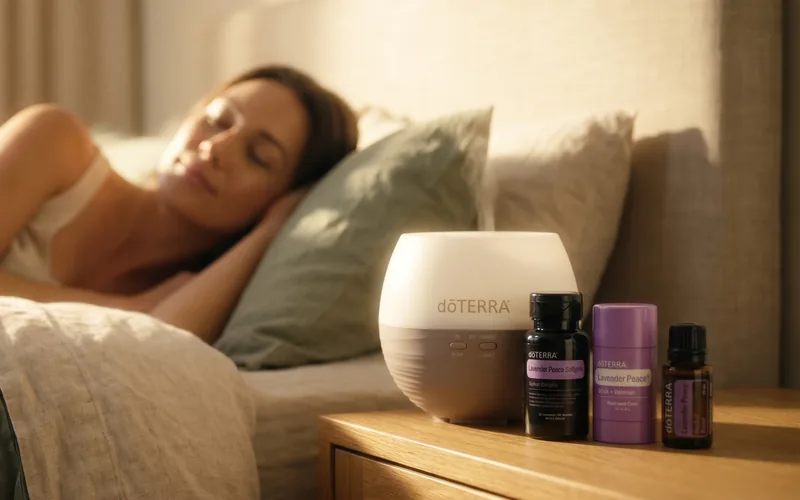
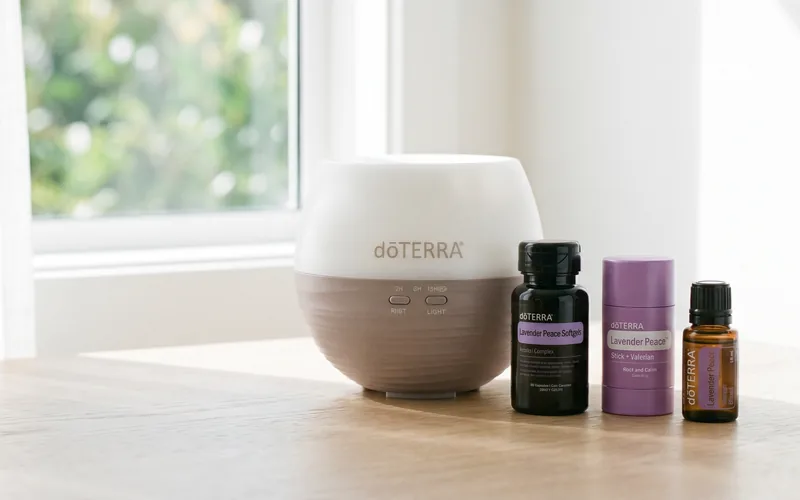
- Bedtime (30–45 min before sleep) — the full protocol. Diffuse the Lavender Peace Restful Blend (or lavender + valerian), apply the Lavender Peace Stick + Valerian to pulse points, and take Lavender Peace Softgels (ARTG 489563 — traditionally used in Western herbal medicine to relieve sleeplessness) with water. Same scents, same locations, same time, to strengthen aromatic anchoring.
Why a complete system works better than individual oils.
Many people start by buying a few individual oils and trying to build their own protocol — which means researching oils, dilution ratios, application points, and diffusion amounts, then experimenting through trial and error. Most try 3–4 approaches (each costing time and money) before something works, and the frustration of failed experiments leads many to give up before seeing results.
Professional blends remove the guesswork. The Sleep Well Pack is a 4-step protocol that addresses both daytime stress and night-time sleep:
- Prevent — Lavender Touch through the day, applied as stress builds.
- Prepare — diffuse the Lavender Peace Restful Blend 30–45 minutes before bed.
- Apply — Lavender Peace Stick + Valerian to pulse points at bedtime, to activate aromatic anchoring.
- Support — 1–2 Lavender Peace Softgels with water (ARTG 489563 — traditionally used in Western herbal medicine to relieve sleeplessness).
Everything arrives ready to use — no mixing, no guesswork, no trial and error. Always read the label and follow the directions for use.
Your questions answered.
How long does it take to see results?
You'll notice immediate aromatic effects — a sense of calm within minutes. The full benefits develop over time as aromatic anchoring establishes; most people notice significant improvement in transitioning into sleep within 7–14 days of consistent daily use. Consistency is the key word.
Can I use aromatherapy if I'm already taking sleep medication?
Essential oils are not medication, and this is not medical advice. If you're taking prescription sleep medication, consult your doctor before making changes to your routine. Many people successfully use aromatherapy alongside other sleep support approaches. Always read the label and follow the directions for use.
Is it safe to use essential oils every day?
Yes, when used as directed. CPTG® Certified Pure Tested Grade testing ensures purity — no synthetic fillers or contaminants. For topical use, follow dilution guidelines (pre-diluted products like Lavender Touch make this convenient). Internal use should only be with products specifically approved for ingestion, like Lavender Peace Softgels (ARTG 489563).
Do I need to use aromatherapy during the day and at night?
A night-only approach works for some, but for most people with busy schedules, daytime stress management significantly improves night-time results. Think prevention (managing stress before it accumulates) plus intervention (supporting sleep at bedtime). You can start with night-time use and add daytime aromatherapy if needed.
Will I become dependent on essential oils to sleep?
Aromatherapy is not habit-forming the way sleep medications can be. Aromatic anchoring is a learned association, not a physiological dependency — you're training your nervous system to respond to a calming signal. Many people who use it consistently find they can reduce frequency once their sleep patterns normalise.
Which is more important: diffusing or topical application?
Both serve different purposes and work best together. Diffusing creates an environmental atmosphere everyone in the room benefits from; topical application is personal, portable, and longer-lasting as the oils absorb through your skin. The most effective protocols use both.